

Hiring the right way is especially important for a startup. It can affect your product roadmap, cash flow, delivery timelines, and ability to respond to changing priorities.
Hiring someone takes about 39 days and costs roughly $5,475, according to SHRM. That’s before salary, equipment, or the weeks they need to get up to speed.
Why so long? You write the job post, sort through applications, run interviews, make an offer, and then wait out a notice period. Each step takes days, and most of them wait on someone’s calendar. The cost comes from job ads, recruiter fees, and the hours your own team spends in interviews instead of doing their work.
Sometimes, the answer is a freelancer. If you have a small, well-defined task that requires a specific skill for a limited period, bringing in an individual specialist can be the fastest and simplest option. But as the scope becomes larger or more interconnected, the management burden can quickly grow. You may find yourself coordinating multiple specialists, reviewing work, resolving dependencies, and keeping everyone aligned, while still being responsible for the final outcome.
Other times, a full-time hire is the right answer. If you are building a capability that will remain central to the business for years, investing in an internal team can create the ownership, context, and continuity you need. But that decision comes with a longer commitment. Hiring takes time, and the real investment extends well beyond the offer letter: compensation, equipment, onboarding, training, management, and the time it takes for someone to become fully productive.
There is also a third option that often gets overlooked: managed delivery.
Instead of hiring an individual and managing the work yourself, you can bring in a team that takes responsibility for delivering the outcome. This can be particularly useful when your requirements are changing, when you need several skill sets at once, or when you need to move quickly without committing to a permanent team structure.
To make that decision easier, we’ve put together the table below. It compares the three common ways to build capacity: freelancers, managed delivery, and full-time employees across the factors that matter most to a growing business.
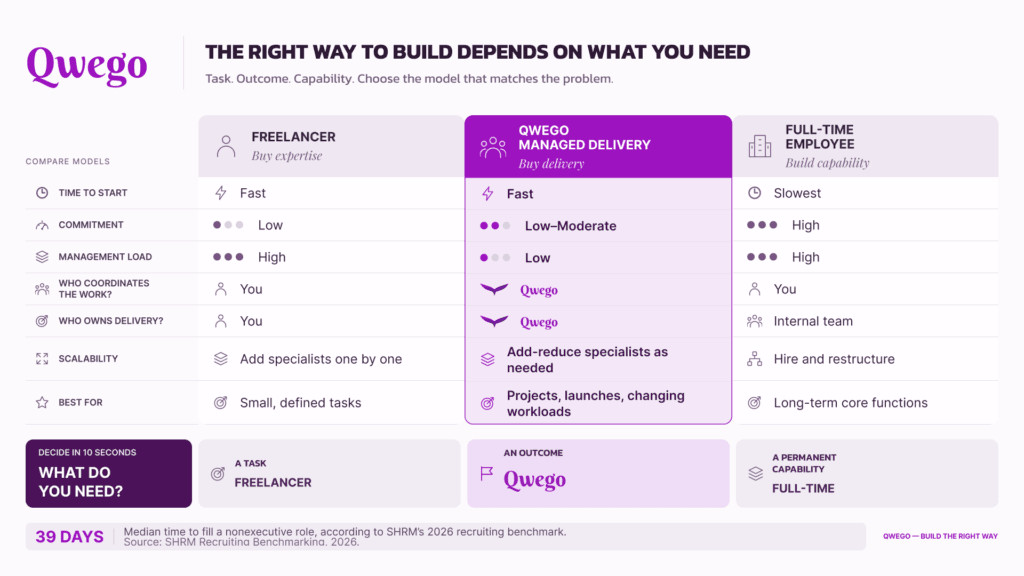
Ask yourself: do you need a person, or do you need the work done? Most projects need the right skills, quickly, with one team accountable for the result. That’s what managed delivery gives you.
The right choice ultimately depends on what your business needs at that moment. If you need a specific task completed, a freelancer may be enough. If you are building a permanent capability, a full-time employee may make the most sense.
But when the requirement sits somewhere in between when the scope is substantial, the workload may change, and you need someone accountable for getting the outcome across the line, managed delivery can be a robust option. It gives startups and growing teams the flexibility to add the right capabilities without taking on more hiring and management overhead than the work itself requires.